Separating Axis Theorem (SAT) Tests written in C99. More...
#include "pico_math.h"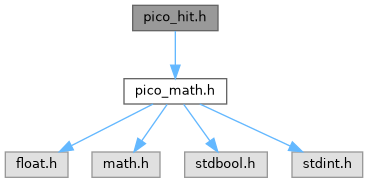
Go to the source code of this file.
Classes | |
| struct | ph_circle_t |
| A circle shape. More... | |
| struct | ph_poly_t |
| A polygon shape Must use CCW (counter-clockwise) winding. More... | |
| struct | ph_sat_t |
| A collision result Provides information about a collision. Normals always point from the target shape to the colliding shape. More... | |
| struct | ph_contact_t |
| A contact point. More... | |
| struct | ph_manifold_t |
| struct | ph_ray_t |
| A ray (directed line segment) More... | |
| struct | ph_raycast_t |
| Raycast information. More... | |
Macros | |
| #define | PICO_HIT_MAX_POLY_VERTS 16 |
Functions | |
| ph_circle_t | ph_make_circle (pv2 center, pfloat radius) |
| Initializes a circle. | |
| ph_poly_t | ph_make_poly (const pv2 vertices[], int count, bool reverse) |
| Initializes a polygon. | |
| ph_ray_t | ph_make_ray (pv2 origin, pv2 dir, pfloat len) |
| Constructs a ray. | |
| ph_poly_t | ph_aabb_to_poly (const pb2 *aabb) |
| Converts an axis-aligned bounding box (AABB) to a polygon. | |
| bool | ph_sat_poly_poly (const ph_poly_t *poly_a, const ph_poly_t *poly_b, ph_sat_t *result) |
| Tests to see if one convex polygon overlaps with another. | |
| bool | ph_sat_poly_circle (const ph_poly_t *poly, const ph_circle_t *circle, ph_sat_t *result) |
| Tests to see if a convex polygon overlaps a circle. | |
| bool | ph_sat_circle_poly (const ph_circle_t *circle, const ph_poly_t *poly, ph_sat_t *result) |
| Tests to see if a circle overlaps a polygon. | |
| bool | ph_sat_circle_circle (const ph_circle_t *circle_a, const ph_circle_t *circle_b, ph_sat_t *result) |
| Tests to see if two circles overlap. | |
| bool | ph_manifold_poly_poly (const ph_poly_t *poly_a, const ph_poly_t *poly_b, ph_manifold_t *manifold) |
| Tests if a polygon collides with another polygon and generates contact information. | |
| bool | ph_manifold_poly_circle (const ph_poly_t *poly, const ph_circle_t *circle, ph_manifold_t *manifold) |
| Tests if a polygon and circle collide and generates contact information. | |
| bool | ph_manifold_circle_poly (const ph_circle_t *circle, const ph_poly_t *poly, ph_manifold_t *manifold) |
| Tests if a circle and polygon collide and generates contact information. | |
| bool | ph_manifold_circle_circle (const ph_circle_t *circle_a, const ph_circle_t *circle_b, ph_manifold_t *manifold) |
| Tests if two circles collide and generates contact information. | |
| bool | ph_ray_line (const ph_ray_t *ray, pv2 s1, pv2 s2, ph_raycast_t *raycast) |
| Tests if ray intersects a (directed) line segment. | |
| bool | ph_ray_poly (const ph_ray_t *ray, const ph_poly_t *poly, ph_raycast_t *raycast) |
| Tests if ray intersects a polygon. | |
| bool | ph_ray_circle (const ph_ray_t *ray, const ph_circle_t *circle, ph_raycast_t *raycast) |
| Tests if ray intersects a circle. | |
| pv2 | ph_ray_at (const ph_ray_t *ray, pfloat dist) |
| Finds the point along the ray at the specified distance from the origin. | |
| ph_poly_t | ph_transform_poly (const pt2 *transform, const ph_poly_t *poly) |
| Transforms a polygon using an affine transform. | |
| ph_circle_t | ph_transform_circle (const pt2 *transform, const ph_circle_t *circle) |
| Transforms a circle using an affine transform. | |
| pb2 | ph_poly_to_aabb (const ph_poly_t *poly) |
| Returns the bounding box for the given polygon. | |
| pb2 | ph_circle_to_aabb (const ph_circle_t *circle) |
| Returns the bounding box for the given circle. | |
Detailed Description
Separating Axis Theorem (SAT) Tests written in C99.
Licensing information at end of header
Features:
- Written in C99
- Single header library for easy build system integration
- Tests overlaps for AABBs, polygons, and circles using SAT
- Provides collision information including the normal and amount of overlap
- Ray casts against line segments, polygons, and circles
- Permissive license (MIT)
Summary:
The Separating Axis Theorem (SAT) roughly states that two convex shapes do not intersect if there is an axis separating them. In the case of simple shapes the theorem provides necessary and sufficient conditions. For example, in the case of convex polygons, it is sufficient to test the axises along the edge normals of both polygons.
SAT tests are reasonably efficient and are frequently used for static, narrow phase, collision detection in games.
This library provides SAT tests for polygons, AABBs (which are, of course, polygons), and circles. Manifold objects can be passed to test functions so that, in the case of a collision, they will contain the colliding edge normal, overlap (minimum translational distance or MTD), and a vector (minimum translation vector or MTV).
Rays (directed line segments) can be cast against line segments, polygons, and circles. Aside from reporting hits, the normal at and distance to the point of impact is also available.
IMPORTANT: Polygons in this library use counter-clockwise (CCW) winding. See the ph_aabb_to_poly for an example.
Usage:
To use this library in your project, add the following
#define PICO_HIT_IMPLEMENTATION #include "pico_hit.h"
to a source file (once), then simply include the header normally.
Dependencies:
This library depends on "pico_math.h", which must be in the include path. You must also add
#define PICO_MATH_IMPLEMENTATION #include "pico_math.h"
to the same or other source file (once).
Macro Definition Documentation
◆ PICO_HIT_MAX_POLY_VERTS
| #define PICO_HIT_MAX_POLY_VERTS 16 |
Function Documentation
◆ ph_make_circle()
| ph_circle_t ph_make_circle | ( | pv2 | center, |
| pfloat | radius | ||
| ) |
Initializes a circle.
- Parameters
-
center Circle center radius Circle radius
◆ ph_make_poly()
Initializes a polygon.
- Parameters
-
count The number of vertices of the polygon vertices The vertices of the polygon reverse Converts a polygon with CW winding to CCW
- Returns
- The polygon with the given vertices
◆ ph_make_ray()
Constructs a ray.
- Parameters
-
pos The origin of the array dir The direction of the ray (normalized) len The length of the ray
◆ ph_aabb_to_poly()
Converts an axis-aligned bounding box (AABB) to a polygon.
aabb The AABB
- Returns
- the AABB as a polygon
◆ ph_sat_poly_poly()
Tests to see if one convex polygon overlaps with another.
- Parameters
-
poly_a The colliding polygon poly_b The target polygon result The collision result to populate (or NULL)
- Returns
- True if the polygons overlap and false otherwise
◆ ph_sat_poly_circle()
| bool ph_sat_poly_circle | ( | const ph_poly_t * | poly, |
| const ph_circle_t * | circle, | ||
| ph_sat_t * | result | ||
| ) |
Tests to see if a convex polygon overlaps a circle.
- Parameters
-
poly The colliding polygon circle The target circle result The collision result to populate (or NULL)
- Returns
- True if the polygon and circle overlap, and false otherwise
◆ ph_sat_circle_poly()
| bool ph_sat_circle_poly | ( | const ph_circle_t * | circle, |
| const ph_poly_t * | poly, | ||
| ph_sat_t * | result | ||
| ) |
Tests to see if a circle overlaps a polygon.
- Parameters
-
circle The colliding circle poly The target polygon result The collision result to populate (or NULL)
- Returns
- True if the circle overlaps the polygon, and false otherwise
◆ ph_sat_circle_circle()
| bool ph_sat_circle_circle | ( | const ph_circle_t * | circle_a, |
| const ph_circle_t * | circle_b, | ||
| ph_sat_t * | result | ||
| ) |
Tests to see if two circles overlap.
- Parameters
-
circle_a The colliding circle circle_b The target circle result The collision result to populate (or NULL)
- Returns
- True if the circle and the other circle, and false otherwise
◆ ph_manifold_poly_poly()
| bool ph_manifold_poly_poly | ( | const ph_poly_t * | poly_a, |
| const ph_poly_t * | poly_b, | ||
| ph_manifold_t * | manifold | ||
| ) |
Tests if a polygon collides with another polygon and generates contact information.
- Parameters
-
poly_a The colliding polygon poly_b The target polygon manifold The contact manifold to populate
- Returns
- True if contacts are generated successfully, and false otherwise
◆ ph_manifold_poly_circle()
| bool ph_manifold_poly_circle | ( | const ph_poly_t * | poly, |
| const ph_circle_t * | circle, | ||
| ph_manifold_t * | manifold | ||
| ) |
Tests if a polygon and circle collide and generates contact information.
- Parameters
-
poly The polygon circle The circle manifold The contact manifold to populate
- Returns
- True if contacts are generated successfully, and false otherwise
◆ ph_manifold_circle_poly()
| bool ph_manifold_circle_poly | ( | const ph_circle_t * | circle, |
| const ph_poly_t * | poly, | ||
| ph_manifold_t * | manifold | ||
| ) |
Tests if a circle and polygon collide and generates contact information.
- Parameters
-
circle The circle poly The polygon manifold The contact manifold to populate
- Returns
- True if contacts are generated successfully, and false otherwise
◆ ph_manifold_circle_circle()
| bool ph_manifold_circle_circle | ( | const ph_circle_t * | circle_a, |
| const ph_circle_t * | circle_b, | ||
| ph_manifold_t * | manifold | ||
| ) |
Tests if two circles collide and generates contact information.
- Parameters
-
circle_a First circle circle_b Second circle manifold The contact manifold to populate
- Returns
- True if contacts are generated successfully, and false otherwise
◆ ph_ray_line()
| bool ph_ray_line | ( | const ph_ray_t * | ray, |
| pv2 | s1, | ||
| pv2 | s2, | ||
| ph_raycast_t * | raycast | ||
| ) |
Tests if ray intersects a (directed) line segment.
- Parameters
-
ray Ray to test s1 First endpoint of segment s2 Second endpoint of segment raycast Normal and distance of impact (or NULL)
- Returns
- True if the ray collides with the line segment and false otherwise
◆ ph_ray_poly()
| bool ph_ray_poly | ( | const ph_ray_t * | ray, |
| const ph_poly_t * | poly, | ||
| ph_raycast_t * | raycast | ||
| ) |
Tests if ray intersects a polygon.
- Parameters
-
ray Ray to test poly The target polygon raycast Normal and distance of impact (or NULL). May terminate early if NULL
- Returns
- True if the ray collides with the polygon and false otherwise
◆ ph_ray_circle()
| bool ph_ray_circle | ( | const ph_ray_t * | ray, |
| const ph_circle_t * | circle, | ||
| ph_raycast_t * | raycast | ||
| ) |
Tests if ray intersects a circle.
- Parameters
-
ray Ray to test circle The target circle raycast Normal and distance of impact (if not NULL).
- Returns
- True if the ray collides with the circle and false otherwise
◆ ph_ray_at()
Finds the point along the ray at the specified distance from the origin.
◆ ph_transform_poly()
Transforms a polygon using an affine transform.
- Parameters
-
transform The transform poly The polygon to transform
- Returns
- A new polygon
◆ ph_transform_circle()
| ph_circle_t ph_transform_circle | ( | const pt2 * | transform, |
| const ph_circle_t * | circle | ||
| ) |
Transforms a circle using an affine transform.
- Parameters
-
transform The transform poly The circle to transform
- Returns
- A new circle
◆ ph_poly_to_aabb()
◆ ph_circle_to_aabb()
| pb2 ph_circle_to_aabb | ( | const ph_circle_t * | circle | ) |
Returns the bounding box for the given circle.